|
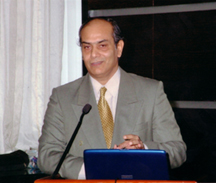
Ajai R. Singh MD |
|
Paper (Oct 2005) on Scientific Temper, Faith and Religion |
 |
|
 |
|
||
|
SCIENTIFIC TEMPER Q1.What is
the essence of scientific temper? A1.The Essence of Scientific Temper This is the essence of science: ask an impertinent question and you
are on the way to the pertinent answer.
- J. Bronowski* It is inconsequential, if not frivolous, to enter into any dialogue of delinking
science from religion, faith, superstition and other such entities. This is the favourite past time of some modernists, and
that brand which prefers to call itself rationalist. Usually, true scientific temper does not have to make any conscious attempt
to delink itself from any thing. The delinking is automatic. Anything that is not objectively verifiable, that cannot be experimentally
proved and does not have the possibility of replication cannot fall within the purview of scientific investigation or research.
That need not negate its truth, or its worth, for nowhere does science claim that it knows, or will know, the whole truth.
All it means is that any truth, opinion or merit it has is extramural to science. It means it falls outside the domain of
scientific verifiability. ... the pronouncements of science are made tentatively, on a basis of
probability, and are regarded as liable to modification. This produces a temper of mind very different from
that of the medieval dogmatist... (And science) pronounces only on whatever, at the time, appears to have been scientifically ascertained,
which is a small island in an ocean of nescience (Russell, 1985, p.480). Parenthesis added. ------------------------------------------- *Cohen and Cohen (1986, p54). SCIENCE’S
FRIENDSHIP/ANIMOSITY WITH RELIGION/FAITH Q2. Can science have any basic animosity, or friendship,
either with religion, religious belief, or faith? A2. Science, the discipline, and Scientist, the man Science can have no basic animosity, or friendship, either with religion, religious belief, or faith. A scientist, however, can. And there is every reason to believe such a distinction can be made,
and legitimately so. A scientist is human, and, being so, has his own share of aspirations, beliefs and hopes which cannot,
however, be a part of the branch to which he belongs. A large part of his energies can be legitimately spent in discriminating
between the two, and not allowing one to negatively influence the other. No doubt he attempts to rid himself of viewpoints
that are not based on evidence. But as regards entities he cannot scientifically verify, or has still not developed the methods
to scientifically study, he prefers not to comment as a scientist, and yet retains his right to believe, reject or defend,
as a human. In this, no doubt, lie shades of his hypocrisy, which is inevitable in all such ambivalent situations. But neither
pointing it out nor condemning it is of any great worth. The latter, if anything, leads to the worship of science, by raising
the branch to the level of a dogma or a faith, which itself can have no less disastrous consequences for mankind. What must
be attempted is a realization of this ambivalence, of this duality of cognition, and a sincere attempt made to allow the bare
minimum of unhealthy interaction between the two. For this, there are two cardinal rules a scientist must follow with regard to his branch. First, he should never be unwilling to accept the worth of evidence, howsoever damning to the most favourite of his
theories. And what follows as a corollary, he should never get emotionally attached to any of his theories, howsoever lovingly
elaborated. The second, and perhaps more important point is, for want of evidence, science withholds comment. For want of objective
data, either way, a true scientist withholds judgment. It is important he withholds it, for passing judgment in the absence
of evidence makes one liable to fall into the trap of either cynical bullying or unnecessary messianism. And a vapid theorizing
whose soaring hopes only make one come crashing to the ground finally. This most science watchers must have realized in the
fall of any number of new fanciful theories that attract instant attention but, unable to stand the test of verifiable evidence,
sink into as rapid an oblivion. Q3. What are the two cardinal rules a scientist must follow? A3. The two cardinal rules for a scientist to follow: DOES BEING RELIGIOUS HELP IN BEING A GOOD SCIENTIST? Q4. Does science, or scientific temper,
need have anything to do directly with how religious or otherwise an individual is? A.4. Scientific Temper and Religiosity Science, or scientific temper, need have nothing to do directly with how religious or otherwise an individual is. That
should clarify why the best of scientists have been both pious and atheists. This is not to say that religiosity, or its denial,
makes them better scientists, although personally they may so claim. All it means is that personal preferences and biases
are difficult to delink for even those who are in disciplines that involve the most rigorous objectivity. Secondly, as far as the question why religion, or its refutation, is accorded diametrically opposite value by the committed
believer or the established iconoclast amongst the scientists goes, the answer is not very difficult. It is more an indication
of their personal qualities of single-minded pursuit and devotion. It is this that makes them rise to the top and gets exercised
as much in their scientific research as their metaphysical opinions. And faith, or its denial, can become important catalysts
in both pursuits. The scientist concerned, however, may give it a totally different, personalized, colour. This, again, is only proof that the scientist is human after all and, in spite of his best efforts, human failings cannot
but become manifest at times. IN A NUTSHELL Q5. What does the true scientist
do? A5.What the true scientist does: One may say that the true scientist withholds himself from passing comment on a phenomenon which his experimental method
can either not verify or which falls outside the purview of his branch itself. That does not mean he shirks his responsibility.
It does not also mean he may not take up this phenomenon for study at a future date, when he develops the necessary methodology
and the expertise. All it means is that at the existent state of his knowledge, he withholds himself from either attempting
something which he cannot scientifically assay, or passing judgment on something he cannot objectively verify. He withholds judgment, mind you. He says neither yes nor no. Often most people err in considering withholding of judgment
to mean no, or the lack of courage to say yes. This is because dislike of a state of suspended animation is natural to human
beings. But the scientist has to constantly live with it. There is hence no justification for such a belief. POSITION STATEMENT OF A TRUE SCIENTIST The true scientist withholds himself from passing comment on a phenomenon which his experimental method can either not verify
or which falls outside the purview of his branch itself. That does not mean he shirks his responsibility. It does not also mean
he may not take up this phenomenon for study
at a
future date, when he develops the necessary
methodology and the expertise. |
||
|
|
|
|
|
|
Enter supporting content here
|